Sunday, 15 September 2013

Babies are like buses

Potentially gross stories about babies getting born (although really you should just man up...)

This week has been filled with drama as per usual for the BMC. I've finished my 2 weeks in surgery and now half way through my final 2 weeks in obstetrics.

I've been trying to catch some more babies but kept missing them, so on Friday I left clinic every couple of hours to check the maternity ward. There were two women in labour, and every time I checked the midwives said they were each 8 and 5cm dilated (the cervix needs to dilate fully to ~10cm for the baby to fit out before the mother starts pushing, usually it takes about 1 hour/cm). I think it turned out that the first person who'd examined one had been a bit generous with her '8cm' hence apparent the lack of progression and the last person to measure the 5cm had been under generous. I missed that one at about 3pm so after clinic I sat in the labour room waiting, determined not to miss the other one. By this point another woman had arrived in labour so I was hopeful I would get at least one.

After about 4 hours neither of the women had made much progress, but I was determined to catch some babies having waited that long. For each of them it was all down to that last slither of cervix to dilate. Eventually they both did - at the same time. The primip (first time mum) was surprisingly much better at pushing than the lady who'd had 3 babies already so hers delivered first. When catching babies it's important to stop the head from coming out too quickly or it can cause a tear. Unfortunately, despite resisting the head to slow it down she still had quite a big tear, which bled a lot. The midwife gave me a suture expecting me to suture it up - something I've done only once before in that location, and with the consultant obstetrician talking me through it. This time there was no consultant and I could hardly see the tear due to the combination of bad lighting and the excessive amount of blood that kept covering it every time I wiped it away. I said I really wasn't comfortable doing it, but for some reason the midwife wouldn't take over. I put one stitch in, which seemed to make no difference, then luckily the consultant walked in the door. She'd been home for dinner but decided to check on how we were doing. I was incredibly relieved because the women had lost a lot of blood and I really wasn't confident about what I was doing.

At this point the midwife decided that the lighting wasn't good enough so the woman should sit on the other bed where there was the (only) lamp. This meant the other woman who was actively trying to push her baby out on that bed had to switch places with the one who had bleed all over the floor. Clearly this was a ridiculous idea, but Ghanaian women are strong and stoic. They barely make any noise when delivering; even the women being sent for emergency C-sections walk to the theatre, so the midwife wasn't about to get a stretcher any time soon. They both stood up, but due to the excessive amount of blood loss the one who'd delivered with the tear collapsed to the floor, luckily caught by the midwife and then me + Dr Coppola. At this point it was deemed reasonable to get her a stretcher and she was moved to by the light where Dr Coppola sutured her up.

While this was happening the first woman decided to push a little harder. Only the bed which she was meant to be on was covered in the other woman's blood so she set herself up on the floor, just centimetres away from the large pool of blood + amniotic fluid. So I delivered her baby on the dirty floor of the labour ward, kneeling on the nice skirt my mum sewed me! As I was waiting for the placenta to come out another midwife rushed in saying a women was delivering in the bathroom. Carmilla quickly rushed off and caught that baby on the bathroom floor. We'd waited all day for these babies to arrive then 3 came at once.


The bed the woman with the tear delivered on (old photo of Erin or Saly's minus the blood!)


The bed with the light - they're in the same room, divided by a thin screen (seen on the right)

I had a bit of drama whilst on call yesterday too which I was going to share, but I think it might be a bit much for some readers! Or at least I think it's a really interesting case from a medical point of view... but potentially upsetting for those of you who aren't quite as objective! Anyone who's interested feel free to ask.


Assabunteng (a Ghanaian PA) with a snake - we get a lot of patients with snake bites and often they'll bring the snake in with them to show us!


A different snake

Tuesday, 10 September 2013

Fighting for their lives


Today I read this article written by the mother of an American boy with a brain tumour.


It made me realise just how different our cultural attitude towards childhood illness is in the West than here in Ghana. I’ve been working at the hospital here for almost 8 weeks and over that time I suppose I’ve become desensitised to the differences. But reading this article really reminded me of how different things are back home. Back home parents will fight with every fibre of their being to prolong their child’s life by 5 minutes. Here… it’s very different.

In my first week here I had a patient with a ventricular septal defect (VSD) – a whole in the heart, so blood goes the wrong way. Although now, as a baby, she is relatively healthy, eventually the girl will develop heart failure (and probably die) if this isn’t repaired. One of the volunteers here had some money raised from home that he was willing use to pay for the girl to have surgery to fix it in Accra (the capital). It would cost somewhere in the region of $2000. Everything charitable here is done through the hospital’s chaplains, so we went to speak to them about the girl. They pointed out the importance of the family taking ownership of the girl’s treatment and suggested that they ought to pay for transport and accommodation. Although this was nothing in comparison to the cost of the surgery, it would make them take some responsibility and stop it being a hand out. We spoke to the mother about it who found it difficult to comprehend as her child is currently relatively well, but was still keen for the surgery (she couldn’t even read her own daughter’s name, so it’s hard to know how much explanation got through by the translator). The chaplains drove to the village to speak to the girl’s father who hadn’t come to see her in the hospital. They explained the situation and the proposal for the surgery, including his involvement of paying transport and accommodation. The father refused to pay. Instead, he said “I have another wife who has already produced another child, I have other older children from this wife, why should I pay? If this child dies, I will have another one.”

At the time I found this heart breaking. How could he love his child so little that he wouldn’t even pay a small amount of money to save her life?

But I think there is a huge self-preservation element to it. Although this has been the most extreme example to date, I think generally people here expect some of their children to die and so prepare themselves for it mentally. I’ve been with many parents as they watched us attempt, unsuccessfully, to resuscitated their dying children and they just don’t react the same way as Western parents do. When we performed a C-section and one of the twins was born dead and handed to me, I asked where shall I put it, and all the Ghanaian staff answered “in the bin”. I couldn’t do it and in the end one of the doctors put it (probably in another bin) in the other room, but at least it wouldn’t spend the rest of the surgery at my feet… The majority of stillbirths don’t get buried here or have any kind of funeral. There’s a concept of a ‘good death’, which would be an old man who has lived a long and successful life and died peacefully, where as a baby born dead is classed as a ‘bad death’ and is therefore not worth the same respect.

In the end, the father of the VSD baby agreed to allow the baby to have the surgery if all of the costs were covered, so she will have the repair… but it’s sad to think how little he values his child.

To be fair, not all parents have been like that here. The hospital (possibly country?) has had a massive shortage of anti-snake venom (ASV) for about a month now. Previously ASV would be covered by the Ghanaian health insurance, but since the shortage families have had to buy it from the black market. Where before patients would normally only need 1 or 2 viles, with the black market stuff they were needing 6 or 7. There’s some question as to whether this is due to it not being refrigerated during transport or if it was even ASV at all. Each vile from the black market costs 160 cedis – more than a month’s wages. Many parents would buy vile after vile of the stuff for their (older) children, bankrupting themselves, so they obviously did care a lot for them. Now the pharmacist has bought in a large quantity and is selling it privately for 100 cedis a vile – still a lot of money, but at least this stuff is actually working.

Sorry this is becoming a bit of a depressing blog! I’ll have to come up with some more penis stories… I have seen another patient who almost got his cut off in January when his shirt got caught in some machinery. He had scar tissue circling all the way round, but luckily apart from some chronic pain, he had regained normal function. Not quite as scandalous as the last one! 


I love this photo of Liz's - all the kiddies get weighed like this before they're seen in clinic

Sunday, 8 September 2013

Photos from Jen's birthday, hospital stuff and scandal in Nalerigu

I thought maybe you guys might like to see some pictures from the last month that I haven't been able to put up before with the internet being broken...

I've been looking through loads of photos (mostly taken by my lovely friends) and got all nostalgic so some of these go weeeks back.


Stargazing on my 2nd (or 3rd?) week here


A baby born with spina bifida


All the scrubs/OR sheets etc get hung out to dry. Now that rainy season is fully underway and it's raining every day we have a big problem with drying enough gowns for surgery. The local staff don't want to hang them up in doors because of they believe the sun kills bacteria (luckily they use a steriliser too afterwards)


Jen's birthday


Me + the Coppola girls made a princess castle cake


And Erin + Saly + Elaine (and possibly some other people?) made an Africa birthday sign


One of my favourite photos!


Group photo strike 2 (sadly without Caitlin... also not sure where Saly is?)


This picture sums up everyone's enthusiasm for clinic pretty well!


Chini - a TB patient who sits outside on my porch everyday... not really sure why... he's very friendly but there's definitely something not quite right up there!


The other week we went to Nakpanduri - an escarpment thing...


Standard drugs cabinet


There's one incubator in the hospital that intermittently works so normally is at full capacity with 3 babies squeezed in. Any other premies/neonates who need it end up on the paeds ward in the open.


This is a baby I saw in clinic the other day who probably has craniosynostosis - a disorder where the skull bones fuse too early causing compression of the brain


I have got some other cool pictures of medical things, but at the risk of grossing you out I've decided not to upload them! If you want to see them you'll have to ask when I'm back in England.

Actually before I go, just time for one quick, potentially gross story mwuhahaha! The other week a man came into the hospital having been pretty badly beaten up. Turns out he had been having an affair with a married women. The husband somehow found out and rounded up his mates who then proceeded to travel to his village and CUT OFF HIS PENIS!!!! So now he has no penis... this was pretty big scandal here in Nalerigu. There's even a video somewhere on the internet that everyone keeps playing. As the story goes, one of the friends who'd been assisting with the assault had accidentally dropped his phone, while being distracted by penis cutting one can only assume... For some moronic reason he then decided to go back for it and the villagers by this point had come out (presumably having heard the agonising screams of a man-minus-penis) and killed him.

Apparently the penis choppers + the women who had the affair have been prosecuted (she told her husband who she'd slept with in the knowledge that he was planning revenge), though I don't know what happened to the villagers who killed the attacker.

Anyway, hope you're all doing well wherever this meets you!

xxxx

Monday, 26 August 2013

The end of paediatrics (kinda)


Warning: potentially upsetting stories about children dying

Sorry it’s been ages since writing on here. The internet at the compound has been broken for almost 2 weeks so I’m using this weird internet USB stick with my sim card that’s very temperamental + slow. Sorry it really can’t cope with pictures!

I finished my 3-week block in paeds yesterday and started surgery today. I was really happy about this. Those 3 weeks have probably been the most stressful 3 weeks of my life. That’s a bit of an exaggeration, but still it has been insane. I have never had so much responsibility over life and death (clearly I need to get a grip back home if this isn't as stressful as some other much more mundane things!).

Over the last 2 weeks I have probably been present at the death of about 15 children, almost all of which I was either the most senior person there or equal most senior with the other med student Liz. Our only qualified paediatrician left a couple of weeks ago so we’ve been running the paeds ward with the physician assistants – who are brilliant + definitely senior to me, but often not there when we’re called to see dying babies. The two of us have done so many paediatric resuscitations I’ve lost count. There have been so many that I’ve even been called to 2 since yesterday morning when I officially stopped working on the paeds ward. Thankfully some of the resus’s have been successful, but sadly most are not.

Some deaths have been really upsetting, particularly when the child has been there a while. Most of them however arrive to the hospital peri-arrest (ie on the verge of stopping breathing/heart beating). There’s a huge social problem with healthcare here. I think a lot of it is parental education – so many of these kids have been ill for days before coming in, but the parents are out in the fields working all day and don’t really pay that much attention or don’t know the signs of when their child needs medical care. There are also difficulties with transport, many patients travelling all day to get to the hospital. Another big problem that I find quite concerning is that all too often these children will be referred from small community clinics where they will have been sat there receiving very little care a few days, getting sicker and sicker, until eventually the parents decide to take them to hospital, by which time it’s too late. There is also ‘local treatment’ – the witch doctors, whose treatment is recognisable by little cuts on the skin over the site of problem.

The hardest death was probably my 2nd resuscitation – a little two year old with cerebral malaria. He had developed a severe pneumonia probably from aspirating during febrile convulsions (ie he breathed in vomit when fitting, the fits being caused by the high temperature + malaria in the brain). Within minutes of his arrival he stopped breathing, but still had a heart beat. As I’ve said before there are no ventilators here, so Liz and I bagged him for an hour and a half (gave breaths using a mask fitted to a rubber globe that you squeeze and it pushes air into their lungs) - really the only kind of resuscitation available here. All of that time his little heart kept beating and I had this vague hope that if we kept going for long enough his antibiotics might have time to kick in… but the combination of not breathing properly during the seizures and the pneumonia had left him with fixed + dilated pupils – a sign that he was severely brain damaged beyond hope of recovery. Eventually Dr Coppola, the hospital’s head doctor who had been coming to see how we were getting on, told us to stop. That was probably one of the hardest things I’ve ever done, knowing that we had been keeping him alive, and then listening as his heartbeat slowed down. Then his mother told us this was her 4th child who had died. We were all really upset.

It really makes you question though, surely after the first 3 children dying, wouldn’t you think to come to the hospital a little bit earlier? There has got to be some kind of educational or cultural or financial issue here stopping the parents from bringing their kids in sooner. It’s not really something I have any clue how to address.


Not all of paediatrics has been sad though. The little 3 year old boy I mentioned a while ago with the chest drain made a good recovery and was discharged a few of weeks ago. I saw him for follow up in clinic the next week. It was great to see his cheeky little face again. By the time he was discharged he’d stopped being scared of me, as his parents were so friendly + I hadn’t stuck him with any needles for a really long time! Every time I went to check on him on the ward would always give me a grin and play hide + seek behind his mum. It was great to see him again and doing so well, although when it came to time for him to leave clinic he ran up to the door and opened it and was gone before his mum could stop him. He had definitely had enough of the hospital!

The two kids from last post had really good outcomes too. The boy with the status epilepticus made a full recovery and was discharged home after a couple of days of observations. The meningitis kid took a bit longer to recover and was discharged after about a week or two with some hearing loss and possibly a mild cognitive impairment but essentially back to normal. (Turns out he’d been at a little clinic for 3 days before coming to the hospital, presumably not on the appropriate antibiotics as he’d been getting progressively worse and got better with us as soon as he was started on them).

So although it is really hard working here, it’s also really rewarding. I’ve spent most of my time here feeling pretty out of my depth, but turns out that’s a brilliant way to learn – if you don’t learn quickly, patients die, so there’s no difficulty in getting motivated!


Now that I’m on surgery I think I will be shouldering a lot less responsibility – unlike my final two weeks of paeds, there’s an actual qualified surgeon in charge.

Tomorrow I’m having my first full day off since getting here, besides ones where I was puking – woopie! I’m going to Tamale with the Coppolas –the head doctor and her family. They have 2 really cute girls (aged 6 + 9) who are a great comic relief in what can sometimes be a really depressing place to live.

Wednesday, 14 August 2013

There’s no such thing as an emergency in Ghana…


(written yesterday)
A couple of weeks ago I wrote about how this place made me lose faith in all that is good in the world. It’s strange working in a Christian mission hospital where they’re preaching the ‘good news’ and seeing so many people in such severe suffering. I have asked a number of the missionaries how can God be good when he allows this to happen. They gave the familiar theological answers, which, if I’m honest I didn’t find entirely convincing when patient after patient has died unpleasant and untimely deaths. I was angry at God for letting these things happen and angry at them for having this unwavering faith in God. Then I realised that I hadn’t actually prayed for any of the patients, and maybe that would help. It didn’t seem to, they still died. Until last night…

Last night was pretty stressful. I was taking paeds call (means you get phoned if patient needs seeing) and had been called in to review a baby whose haematocrit was 8% (level of red cells in the blood, which should be 26-50%). I went up to the hospital with Elaine who was on medical call for the adults. We were about to walk to the hospital when I suddenly thought, "we should take the truck". The thought just popped into my head out of the blue. We parked up and were just walking in the front of the hospital when I noticed a (11y/o) boy who looked very unwell sitting in the porch. After about 30 seconds of questions it was obvious that he had meningitis. He had textbook symptoms and looked just like the other children I’ve seen this trip with the same condition. Meningitis is something we get drummed into us at med school, though I’ve never seen any confirmed cases in the UK. The most important thing is to get antibiotics started as soon as possible, worry about getting a lumbar puncture to confirm diagnosis later. Only this is (northern) Ghana… There is no such thing as an emergency in (northern) Ghana. There is no emergency room. There are no emergency antibiotics ready. They probably wouldn’t have even seen a doctor that evening if we hadn’t have driven – if we’d walked we would have come through the back entrance and missed them. Instead they would have been seen at some point by a ‘medical assistant’ – the Ghanaian equivalent of a nurse practioner, who have limited training and are very variable in ability.

Because this is Ghana, where urgency is not a concept, the boy had to wait until he had a folder made up – probably the single most frustrating thing about this hospital is that nurses won’t administer drugs until a prescription is written in the chart. In England he would have been straight in resus, with an IV line and antibiotics given before you could blink, nurses following oral instructions, with written prescriptions later to follow. But not in Ghana… so we had to wait at the front of the hospital while the boy had a new chart made up. As you can imagine I was not very impressed with the poor man working in the booking office who was painstakingly copying down the boy’s insurance details.

While this very slow process was taking place another 11 y/o boy arrived, being carried by his older brother. He was actively seizing, had vomited and was incontinent. His brother, who luckily spoke a little English, was eventually able to explain he’d been like this for over 40 minutes. Again, textbook medical emergency – status epilepticus (continuous seizures), something drummed into us at med school: prolonged seizures give benzodiazepines, then phenytoin, then if they’re still fitting, call the anaesthetist + intubate (stick in a breathing tube + ventilate with a machine). Only here in northern Ghana we don’t have anaesthetists, we don’t have ventilators, we don’t have phenytoin and we don’t give medication until the patient has a chart…

By this point I was close to losing it with the folder-making man as he photocopied the insurance card then wrote out all the details… I wanted to say ‘this child will die if you don’t give me that f***ing chart’ but since his brother spoke some English I stuck to “this patient is seizing, I really need his chart quickly to write him some medicine or he may stop breathing”. Something I’ve noticed here, however close the patient is to death, being firm but calm gets things done quicker than getting mad.

Eventually we got the chart and made it up to the ward. I’d sent Elaine off with the meningitis kid already, and when I arrived with another (potentially dying) patient the staff weren’t very impressed. “We are full, there are no beds” they said, to which I responded “This boy does not need a bed, he can lie on the floor, he needs diazepam.” To be fair, the nurses on this older kids ward were much better than my previous experiences with the nurses on the babies’ ward in the same situation, and after a little fuss about the bed situation gave him diazepam quickly. Luckily by this point the paeds consultant who I’d phoned arrived to take control of the situation.

Allowing prolonged seizures can cause brain damage or death, so it is vitally important to stop them. Unfortunately however the anti-seizure medication causes respiratory depression (decreased breathing). In a hospital that doesn’t have any ventilators this is a sticky situation to be in – give too much meds and they’ll stop breathing, don’t give enough and the seizure will continue. Over the next 30mins or so we gave him another dose of diazepam and two doses of phenobarbital before he stopped fitting, luckily without stopping him breathing. All this was done on the dirty floor between two other kids’ beds.

When the status epilepticus kid was under control we could turn our attention back to the meningitis boy. Unfortunately the nurse who was meant to be administering his antibiotics, which had been written up, didn’t quite have the same sense of urgency as the rest of us. The antibiotics wasn’t available on the ward, so she said she would go and collect it from the pharmacy. After the 30 mins of the other patient seizing on the ward she still hadn’t collected it, and only went when I said I would go. Eventually she collected it, we transferred him to isolation (meningitis is contagious), gave him the antibiotics and I performed my first lumbar puncture, confirming the diagnosis – pussy spinal fluid came squirting out at high speed (a lumbar puncture is where you stick a needle into a patients spine to remove fluid to test for infection in the layers covering the brain).

After all this I eventually made it to see the baby with the haematocrit of 8% and ordered him a blood transfusion. There is no blood bank here so the family members find a match to donate, which can take some time.

The three kids were on my ‘will they be there in the morning’ pre-rounds check. This morning all three kids were there – alive. I checked on the first two again tonight – both were sleeping, so I didn’t disturb them. The seizure kid’s brother said he’d been awake in the day, eating and behaving normally. I was really surprised – after seizures for ~1½ hours I expected him to be comatose or at least have some kind of disability (like other kids I've seen here). I didn’t do a full neurological exam as a different doctor already saw him today and I didn’t want to wake him, but it’s sounding hopeful. The meningitis kid is still very sick, but the mum said he was “better” (they all say that) and that he knew he wasn’t at home, but still confused. He looked less sick than yesterday. Time will tell.

I started this post talking about how I was angry at God for the suffering here until last night. Over the years I’ve ranged in opinion about God from strict Christian to virtually atheist, so I completely appreciate that most of you will see this as coincidence – for a long time I would too. But last night I had this weird sense that God was looking out for these kids, and using me and the other doctors/students to save their lives. Elaine + I were so close to walking the back way to the hospital, where we wouldn’t have seen either of these children as they came in. It’s impossible to know what would have happened if we hadn’t been there, but I think since I ask God to help save the patients, I’ve got to give him credit when it appears that he does.


Today wasn’t quite as eventful, but still busy busy. Before lunch (after rounds) I removed my first onchocerciasis nodule (river blindness --> calcified parasites), aspirated a Baker’s cyst and helped Zato with a skin graft: photos courtesy of the lovely Caitlin.

First you collect your graft with a metal instrument that's a bit like a cheese grater


Then you put the graft through this machine - it cuts little lines in it so it stretches to about twice the width


Then you place the grafts onto the wound

Arrange them nicely, staple them in place


And dress the wound


Removing the onchocerciasis nodule


Niiiiice


Saturday, 10 August 2013

Pictures, clinic and snake bite kid update


This week has been a bit more chilled, partly cos I was ill so missed half of it, but also cos a whole load of doctors arrived last week, giving about double the number than before, which is great.

I’ve been on paeds this week which is good, but a little out of my comfort zone. About 80% of them have malaria though, so I’m pretty comfortable with that now!

Cute Kids in town:


Me with some of the other doctors/volunteers + local kids


As I said before, Mondays, Wednesdays + Fridays are clinic days. They're usually really busy. The patients start lining up at 5.30am to register. At some point in the morning they get their blood pressure and weight checked.


Then they wait in this porch area until they're seen by one of us. Clinic usually finishes around 6pm so many of the patients are waiting for hours and hours. There's no appointments, I think it's basically first come first serve.


This is me at my clinic desk that I share with one of the medical doctors. Flying the Peninsula flag in Ghana! 


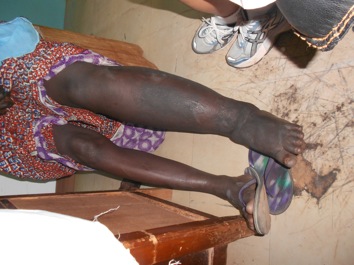
This is my colleague Elaine's patient from clinic yesterday who I diagnosed with Elephantiasis. It's caused by a parasite and is really rare in the UK, but the second case I've seen out here. The treatment here is just a single dose of Ivermectin. Later in the day the patient came back complaining that they lived very far they hadn't been given enough medicine, so Elaine gave them some paracetamol as well. Patients expect to be given lots of medicine on every visit, so even if they don't need anything you have to prescribe them some paracetamol or multivitamins or they'll barge back into the office to complain.


In England when patients demand prescriptions it's ok to say no, but here it's simpler just to given them vitamins - they probably need them anyway! 

The language barrier is a big problem here. We work with translators who are usually nurses or nursing students and vary greatly in their medical + language ability and enthusiasm. I've been getting much vaguer histories than I would in England. It seems every patient I see has waist pain, chest pain, head pain and general body pain. I try to narrow down what's going on, but the translators don't seem to understand words to describe the pain like sharp/dull/burning. Almost all of the time when you ask how long they've been ill they'll say 3 days or 3 weeks. Time is a different concept here, much less rigid. There's a nice phrase I heard the other week: 'American's have watches, African's have time' (all the non-Ghanaian's here apart from me are American).

This is the boy whose photo I put up a couple of weeks ago who'd had a snake bite (scroll down). I watched Zato do his skin graft about a week ago and have been doing his dressing changes on alternate days. It's looking really good!


Hope you're all doing well! Sorry I've been rubbish at replying to people's messages - the internet is really temperamental, but I really really appreciate hearing from you all! I wrote a load of replies the other day offline and had them ready to send, then my laptop ran out of battery and I lost them all :( I will try to write soon though! xx

Thursday, 1 August 2013

Life in the hospital


Sorry it’s been so long since I’ve written anything on here, it’s hard to find the combination of time and energy.

This last couple of weeks has been really challenging, both academically and emotionally. It’d be very easy to come on here and say what an incredible time I’m having and how I’ve been able to do so much awesome stuff. That is true… but it wouldn’t be a very genuine representation of my trip.

For example yesterday I got to put my first chest drain in (w a lot of guidance) – awesome experience, something I’ve never even watched in England, let alone been able to do myself. (It’s a tube, about the thickness of a finger, that you place between the linings of the lung to drain pus/fluid/leaked air).

The other side of the story, that doesn’t make for such an upbeat blog, is the reason I put the drain in in the first place. The patient was a muscular 30-something year old man with AIDS pneumonia. He had such damaged lungs that a leak had formed, leading to air filling his chest and crushing his lung. For about 6 hours after I put the drain in and released the air he looked great; he was breathing much better and he would thank me + Jim (who did it with me) whenever we went to check up on him. I was feeling so pleased. I thought he would live long enough for the antibiotics to have a chance to kick in. In the evening however he was looking as sick as he had that morning and when we went for rounds this morning his bed was empty – he died in the night.

Every morning I check certain beds to see if they’re empty, looking for patients who the night before have been on deaths door. About 50% are still there the next day.

For every tragedy though, there is the other 50% who make it through the night, and have time for the antibiotics/blood transfusion/fluids to kick in.

One of my favourite patients is a little 3 year-old boy on paeds. He saw our surgeon in clinic with a bulging fluctuance on his chest that felt just like an abscess. We took him to theatre and Lisa talked me through my first ‘I&D’ (incision and drainage). This is normally a very straightforward procedure involving a small incision and squeezing the pus out of the abscess. Once he was anaesthetised I made the incision and the pus came flowing out, and kept on flowing. In total we drained about 500ml from this tiny guy's chest. When the flow had slowed a bit it began coming out in little bursts as he breathed – it turned out the collection was coming from the lungs and had eroded forward to the skin. This was pretty unexpected, and he now had a sucking chest wound. Luckily Lisa managed to put get a chest drain in quickly and suture him up – so glad I wasn’t doing it on my own!

The next morning I went to paediatrics, half expecting to see an empty bed. Instead I found a well looking baby and a happy dad. As soon as the kiddy saw me he started screaming cos he thought I was coming to do another procedure on him. His dad thought this was hilarious, so now every time I go into paeds his dad always gets his kid and shows him to me. The poor little kid hates me, but me and his dad always laugh so much when we see each other. Draining the pus and fitting the tube saved that kids life, so I don’t feel too bad! (Having said that he’s definitely not out of the woods yet, but doing well considering)

There have been so many times over the last two weeks when I’ve really question all that is good in the world. There’s so much suffering here, so many young patients dying. But as Jim always says, you’ve got to remember the patients you have helped as well as the ones you couldn’t.

I’ve seen some pretty horrendous things here, but I’m not really sure how much you guys want to hear about that kind of stuff… As well as being a staff + resource poor hospital, it’s the only hospital for about a hundred mile radius, and so often only the really sick ones will travel that far, giving a disproportionate picture of health in northern Ghana. Before coming here my (half) Ghanaian friend Marie kept saying ‘why do you want to go to the North, healthcare is rubbish in the North’. Well that’s why I wanted to go to the North, and I’ve really experienced that, and some. Maybe that's not fair, but it's certainly very different.


The choir at First Baptist Church, Nalerigu


My friend Hamsa


All the women carry their babies like this and little kids carry the even smaller ones