Sunday, 12 February 2017

Garden Pics, Curry Night and Chicken Drama...

In case this blog is getting a bit medical, here are some pictures of the garden. I know my mum wants to see them, even if no one else does! And let's be honest, the whole point of blogs when you travel is to keep mums happy!

This is the front where I've planted some sunflowers, and the first one has just come out. I think the plants on the sides are cannas.
Then at the back I've got courgettes:
Sweetcorn:
Mange tout:
Basil:
And a few other bits that haven't grown much yet (tomatoes, carrots, swish chard). It's funny how some things have grown really well and some things have completely failed - I also planted chillies, salad, peppers and sweet peas which haven't grown at all.

Look what I brought back from home! Sorry about the mess, the grass is left from Benson fixing my fence.
I'm keeping the hammock in doors, but left the ropes on the papaya trees and annoyingly someone has nicked them... but I'm sure I can find some more rope somewhere.

Over Christmas we had a lot of storms and a lot of my fence completely fell down. I got Benson to rebuild it while I was away. He did a great job, but then I woke up the other morning to find my neighbours papaya tree had fallen down and broken it again! (Knocking down one of my sunflower too...) Luckily the leftover grass meant Benson could fix it again without too much trouble.
We get a lot of power cuts so I bought a fire pit in town. It's quite difficult to light, but once it gets going it's great. Made tandoori chicken tikka on it for our curry night last night.
(No this is not chicken...)
We had so much food, it was great! We've had a lot of new doctors arrive since I last put up people photos, I think all in medicine.
 Left to right: Raqib (medicine F5), Pete (medicine F4), Adam (surgery CT3), Kars (research officer), Nicola (medicine F3), me (O&G F3)
Sammy (surgical F3), Tim (GP), James (O&G ST5), Kate (physio), Becky (medicine F3)
There's also Marloes (surgery F4), Alex (surgery ST6), Ken (medicine F4) and James (medicine CT3) who are in various places ranging from South Africa to the hospital! And 4 medical students who are in Malawi/Livingstone at the moment.

There's some sad news about the chickens... since coming back from UK a couple of weeks ago Martha hasn't been seen - she's missing, presumed eaten! Pete's trying to persuade me that Chicken Run is a true story ("Apple pie? My favourite!") and that she's off enjoying life in a field somewhere... but I'm sure she's become someone's dinner. Possibly someone human, possibly someone dog!

Chicken photos as promised!
Martha, RIP!
Nkuku and Chicken Licken actually seem happier without her; I think she was a bit of a bully. They seem friendlier and are now BOTH laying most days, which is the most they've laid since I've had them. I was thinking of buying a replacement, but I don't actually need more than 2 (small) eggs per day so probably won't bother.
Chicken Licken getting extra friendly! They're also worryingly interested by the fire pit...
And since I also promised sunset photos...
I brought a volley ball back from UK and have made friends with a lot of the local kids who LOVE playing basket ball with it.

Sammy plays basket ball with a bunch of men, but the kids are definitely more my level!

Tuesday, 7 February 2017

Home, Dopplers, Emergencies and Mega Fibroids

Warning: graphic pictures at the bottom, view at own risk!

Sorry it's been forever, life has been busy! I went back to the UK for 10 days because I had a job interview for the 7 year obs & gynae training program. Everyone keeps asking how it went - who knows! I can think of lots of things I could have said/done better, but overall I think it was OK. It's pretty competitive though, so we'll have to wait and see! 

It was a major effort, but was so great being home, seeing everyone and eating all the food! At the beginning of the week I was feeling a bit unenthusiastic about coming back. We were really busy in the period leading up to me going away as our 2 O&G registrars from Lusaka had left and their replacements took about 4 weeks to turn up. But they're here now so we've gone from doing 1 in 2 on calls to 1 in 5, which is SO much more manageable. It really felt like coming home, returning to Katete, even if it is a fairly stressful place to live! All the nurses and even some of the patients were asking me where I was/had I had a good trip, which was really sweet. 

The Dopplers have gone down very well. Thank you all SOOO much for such incredible generosity. There was an almost overwhelming response, to the point were I could have bought about 20 dopplers with the number of people who offered. It's was so kind of you and it will make such a difference. In the end I bought/received 2 dopplers, rechargable batteries, a battery charger, a HUGE thing of ultrasound jelly, some urinalysis sticks and some pregnancy tests. I've taken in one doppler, the charger, jelly and half the urine sticks/pregnancy tests and kept the others at home for the minute to see how we get on with the first lot. The doppler has been used a lot already. It's fairly straight forward, but James said he'd do a teaching session for the midwives with me to make sure they know how to use it properly.
When I took this picture I was really careful to not get the lady's face (confidentiality) but it didn't occur to me that it's probably not appropriate to have her boobs in the picture until I'd uploaded it! Our patients spend most of their time naked or at least topless so I've got a bit desensitised!

It's SO much better than using the pinard stethoscopes. During my on call on Sunday I picked up a patient with fetal distress who was having decelerations after each contraction. I should be able to pick that up with a pinard too, but it's SO much clearer with the Doppler, so less likely to miss things, and it means you can listen for an extended period of time without getting back ache from bending down for so long (with pinards you have your head about 10cm away from the patient's belly). 

On Friday we had a manic morning - me and James were on labour ward and we had a lady having eclamptic seizures and uncontrollable high blood pressure, then another lady had a bleed in labour (APH). It was difficult to decide who to section first as they were both at risk of dying if left untreated for too long. We took the bleeder first while the eclamptic lady's BP was hopefully coming down on medication - she wasn't able to have a spinal anaesthetic as she was too confused/agitated and a general anaesthetic makes your BP even higher so risks giving them a stroke. So you treat the BP first and then do a section under GA.  

It turned out the APH was caused by a large placental abruption (blood collecting behind the placenta, causing it to separate from the womb). We managed to stop the bleeding in theatre, but unfortunately post-op she had a large PPH (bleed post-delivery). We tried the usual methods to get it to stop (rubbing the uterus to encourage contractions and giving medication - oxytocin and misoprostol) but these were unsuccessful, so James did a balloon tamponade. You get a catheter and tie a condom on the end and put it inside the uterus, vaginally, and then fill the condom balloon up with water and the pressure (hopefully!) stops the bleeding. 
While he was doing that I went to check on the eclamptic lady who was waiting in the theatre corridor for her section. She was being seen by Dr Makukula, our consultant. Whilst waiting for the theatre to be free she had become fully dilated so could be delivered vaginally, with assistance. Much to the amusement of the general surgeons, we took her into what's essentially a broom cupboard off the corridor and attempted a kiwi suction delivery. Unfortunately things went from bad to worse as she then had a shoulder dystocia - the head came out but the body was stuck because the shoulder was impacted behind the pubic bone. After a lot of pulling and pushing eventually the baby came out, not in a very good condition. I took him through to the main theatre where we have a resuscitaire, and after about 20mins of resuscitation we got him to breath (like I said doing the newborn life support course really was the best thing ever!) Then on top of everything, while the baby was being resuscitated the mother had a PPH! She was rushed into theatre in case we needed to do a balloon tamponade on her too, but luckily this one did stop with the medication.

So we managed to see about half of all possible obstetric emergencies in two patients in one morning! As my housemates back home will tell you I actually really love working with these kinds of emergencies, as long as there's good senior support. Perhaps it's a little strange, but what I actually find stressful about being here is that often I'm left doing mundane things, like the ward round, on my own. Whilst there are rarely emergencies on the ward round, there are a lot of complex patients and often I don't feel comfortable making decisions for them (generally I write a LONG list of questions and then find James).

Then after all the madness settled down we got on with the elective surgery and I assisted Dr Makukula and Dr Kiniyki in removing the BIGGEST fibroid uterus I have ever seen. Here come the gross pictures!!

See how small my pen looks next to it - that's a regular biro!!

Sorry this blog has got quite medical lately! I'll put some pictures of chickens or sunsets or something next time!!

Tuesday, 10 January 2017

A small opportunity to make a big difference

A couple of days ago I was on call and was called in the middle of the night to see a girl on labour ward. She was a 19 year old primip (first time mum) who was having a prolonged labour. Following advise from my registrar James I prescribed her some oxytocin to make her contractions stronger. This is something we use regularly at home, and dramatically reduces the rate of needing to do c-sections for dangerously long labours. In many ways it's a fantastic drug, but you have to be careful not to give too much or you can make the contractions too strong/long which reduces the baby's blood flow from the placenta. This is relatively easy to monitor, by listening to the baby's heart rate frequently to check it doesn't drop - a sign of distress. If it does then the oxytocin infusion can be slowed down or stopped.

At home all women on oxytocin will have continuous monitoring of both their contractions and the baby's heart rate with a CTG - a fancy machine that draws lines showing how they fluctuate up and down. Here we have a pinard - a plastic or metal tube that you place on the lady's tummy and listen! 
We haven't used them in the UK for many years (outside of exams!). They're notoriously difficult to use, firstly just to find the baby's heart beat and then to count the beats - a happy baby should be going at 120-160 beats per minute, so that's pretty difficult to count accurately!

After starting oxytocin, the policy here is that the midwives listen in every 15 minutes and we review patients again at 2 hours to check they're progressing well. I went to see my lady at 2 hours and she was fully dilated, and had been pushing for 30minutes. The midwives were concerned that the baby had a big head and she was OP (back to back) which makes it much harder to deliver. They had recorded a good fetal heart beat throughout though, so I wasn't too concerned. I was just about to call James in to see if maybe we should try a suction delivery, but thought I'd see how well she was pushing first. The head came down really well so we kept going and within a few minutes the baby was out. 

When it came out it was blue and completely lifeless except a slow heart beat, making no effort to breath, let alone cry. I quickly rushed it over to the resuscitaire where me and one of the midwives bagged it for 20mins - doing the neonatal life support course before coming here was literally the best thing ever! Initially its heart rate picked up but it still wasn't making any effort to breath. Eventually after about 15 tense minutes it started gasping and then properly breathing for itself. When it was breathing regularly we transferred it to the Special Care Baby Unit for oxygen therapy (basically a very hot room with one oxygen concentrator which has split tubing for up to 4 babies). It looked seriously unwell, hardly moving, so I was really worried that it would have a hypoxic brain injury. In the morning it looked a LOT better, was moving all four limbs and crying, but it's really hard to know what the long term effect of that hypoxia will be. 

The next day I discussed the case with James - had I done something wrong by giving her the oxytocin? He reassured me that no, oxytocin was the exact right thing to do, if she hadn't had it she would have needed a c-section, which out here in a primip is an last resort because they normally go on to have 6-8 kids. No one wants to do a c-section in someone who's had more than 2 previously, let alone 7!

The trouble is, he said, we'll never really know exactly what happened because of the lack of accurate monitoring. The most likely thing is that the baby was having bradycardias (slow heart beat) but that the midwives weren't picking them up. Had they been picked up we could have slowed the rate of the oxytocin infusion or held it and given the baby a rest +/- taken her for a c-section. 

There's a fairly simple solution to this, and you may have guessed my ulterior motive for telling you this story! 

CTG's are incredibly expensive and delicate machines that wouldn't last long out here - in fact there actually is one in a store room, but it's unusable because it's run out of paper! (Like the ECG machine! Or maybe that one's run out of ink...) Instead I am hoping to obtain some handheld dopplers. These are simple devices that are basically a mini ultrasound that project the sound of the baby's heart beat and count the rate for you. Midwives in the UK use them for home deliveries. I've spoken to James about this suggestion and he agrees that having such a simple small device would a) encourage the midwives to listen in more regularly, for longer and b) give a much more accurate reading of the baby's heart rate, allowing us to pick up fetal distress and act on it much sooner. They're really not very expensive (about £30-40) and only need AA batteries and ultrasound gel - the first can be rechargeable and the second is something we have here anyway because we have an ultrasound machine.
A lot of people I have spoken to at home have said they wish they could do work like this, but don't have a career/personal life that would allow them to move halfway across the world. Would any of you like to help me and the team deliver babies more safely by investing in one of these devices? It would be an amazing gift to the hospital and I feel sure that it will significantly reduce the number of bad outcomes. There's also no worry about things getting lost-in-transit as I'm coming home next week for a job interview, so plan to take them back out with me when I return.

I imagine there are a few people who might be interested in helping us out so here are a few suggestions of things people might want to buy, with a variety of prices. If any of you are able to buy one of the following it would incredible! (Where I've put 4x gel etc I mean 4 people could buy one gel each)

2 x handheld Dopplers - £30-40 each (I'm waiting to hear back from my UK labour ward lead consultant on which one is best)
4 x ultrasound gel - £4.95 each (this one @ £2.50/any of them are also fine, but they seem to be add on items, so don't think you can buy them alone)
1 x battery charger (includes 4 AA batteries) - £17.99
4 x spare batteries - £7.79 each

If you do want to buy one of these things, firstly thank you SO much, and secondly please don't buy it without speaking to me first - partly because I'd like them to be sent to my mum's house and partly so I can make sure there are sensible numbers of each item, since I'll be carrying them! Also unless you've agreed with me first please only buy those specific ones as I've spent quite a long time looking through the different options and they seem to be the best combination of quality and value for money.

Thank you guys so much! Sorry this is an entirely shameless post asking for money! In a way I feel bad asking, but actually it's a fantastic way in which you can make a real difference to a significant number of people's lives without even getting off the sofa, and you know exactly where your money is going. We all spend a lot of money on ourselves, which of course isn't wrong, but it's so great to have an opportunity to be generous and to see the impact it makes. Lots of people wrote to me last week saying how good it was to be reminded of how much we have in the West, so this is a chance to use what you've got for good!

Being honest, I can't guarantee they won't be stolen, but the hospital is actually very good about keeping tabs on its equipment. The other week a glucose monitor went missing and there was a big commotion until it was found. Turns out it had just been borrowed by another ward. So I'm reasonably confident that they will stay put!

Sunday, 1 January 2017

A few thoughts on the New Year, with love from rural Zambia

I'm not sure if I'll post this, but I want to write down a few thoughts I've been having lately...

It's a little strange living here in Zambia, watching the rest of the world through BBC news and social media. I'm sure it's a fairly distorted view of what's going on back home, but a few things keep cropping up at the turn of the year, so they must hold some truth about how the nation is feeling. The main theme on social media at the moment seems to be "Thank **** 2016 is over" and "what can I take for myself in 2017" or "how can I make 2017 better for me than 2016?"

I know 2016 has brought us some serious curveballs, and I was among the sorely disappointed at the results of Brexit and the US election, but I suppose I want to challenge all of us, myself included, to take a step back and appreciate what privileged, stable lives we live. We may not be pleased with the outcome of these votes, but we mustn't forget how incredibly lucky we are that we have a democratic political system that is not based on corruption, where as a nation we are able to change the course our country takes.

It's also interesting watching the responses to the many celebrities who have died this year. I don't mean to undermine the grief that their families are going through, but living here does bring a different perspective to death. Working in obs and gynae, back home you ask patients how many pregnancies they've had, including have they had any miscarriages? Here I ask my patients how many pregnancies they've had and how many of their children are alive. A typical history will look like this:
2001 - stillborn at 9 months
2002 - spontaneous vaginal delivery, alive
2004 - spontaneous vaginal delivery, died at 3 months
2005 - spontaneous vaginal delivery, alive
2006 - spontaneous vaginal delivery, died at 5 years
2008 - c-section, neonatal death
2009 - c-section, alive
2010 - miscarriage at 3 months
2011 - c-section, alive
and so it goes on... Back home we use an abbreviation system to denote how many pregnancies a women has had (gravidity) and how many she has carried to 24 weeks (parity), so someone might be G3P2 if they've had 3 pregnancies and carried 2 to 24 weeks. Here we have a third abbreviation - alive. The above woman would be G9P8A4. 

The idea that we can live in a nation where people are genuinely upset that actors/pop-stars - people we don't know personally - die in their 50s and 60s, over here seems a little ludicrous. I don't say this in any way to criticise people who are grieving loved ones. I just want to remind us what a privilege it is to live in a country where we have a very high standard of healthcare, free at the point of access, so we don't frequently have to experience the natural course that life often takes. It's so easy to complain about waiting 30 minutes to see the GP, and to forget how lucky we are to have a GP to see in the first place. At home we don't have to decide whether we can afford to sell the last cow to pay for our 10 year olds chemotherapy or whether actually the rest of the family won't be able to survive if we do that. We don't find ourselves in the position of being transferred from one hospital with a live, but threatened pregnancy, because they don't have enough equipment left to do any more c-sections, only to find that by the time you arrive at a hospital that can, that the baby has died. These may not be easy things to think about, but this is a daily reality for many of my patients, who have done nothing "wrong" to be born into such different circumstances.


The second half of this little ramble is to challenge how easy it is to get caught up in self-serving and to think that perhaps there are some better things we can focus our efforts on in 2017 than just "getting really fit so people will find me more attractive" or "earning more money this year". I feel challenged as we enter the new year, not to be seeking what can I take for myself, but to look at how I can live more generously. I haven't quite figured out how I plan on doing that but here are a few thoughts. 

There are a few of people who wander round the hospital compound begging or looking for work. There's a man named Andrew Phiri who comes to my house asking for bottles of water, blankets, anything he can sell/knows the English word for. He's a sweet guy, but is an alcoholic and doesn't inspire a huge amount of confidence that anything you give him will benefit him beyond buying himself more booze. Because of this and because I didn't want to encourage him to keep hassling me I've not given him anything more than the odd bottle of water. I justified this by the (not unreasonable) argument that giving people hand outs isn't a sustainable form of charity and is of little long term value.

And yet there's a lot of irony in this situation... I think I've mentioned before we have a number of animals living on the hospital compound who have a fairly communal ownership. There are 2 dogs in particular who have wormed their way into our group - Tiger and Danger. They're a bit of a nuisance, but are sweet enough and everyone has a bit of a soft spot for Tiger. Every evening they let themselves into the mess where we have dinner and if there's any food left on our plates often we feed it to them. They're pretty skinny and despite the complaints we make about them smelling bad, we're all mildly concerned about them going hungry. One of my colleagues even went as far as buying dog food for Tiger in Chipata.
Tiger looking very pleased with himself having just dug up half of my sunflower seedlings!

I've been challenged lately - why am I concerned about the dogs going hungry and yet I allow myself not to be concerned about the humans? This hit home the other day. For Christmas, among other things, I made a trifle using some stale cake that Kars and Marloes gave me. There was more cake than could fit in the pudding and since it was already stale and we had so much better food on offer, I didn't particularly want to eat it. It sat on my table for a day getting more stale, then I put it in my kitchen bin where it sat for a few more days, until I took the bin out. As I was emptying the bin I remember thinking how gross it had become - there were rotten mangoes that had started to go mouldy! (Don't judge, it's hot and I'm busy :P)

Later that day I saw Andrew Phiri and we had our usual nonsensical chitchat (his English is poor and his brain pickled), when suddenly I noticed him holding the piece of discarded cake. I know what was in that bin - he must have been seriously hungry to think that this cake was a good meal! I was talking to Alex about how this bothered me and he pointed out the unsustainability of feeding Andrew Phiri. In many ways I entirely agree. But then why do we feed the dogs?! Surely the same argument applies. 

I'm not really sure what the solution to this is, but I just feel a bit sick that I allowed myself to be more concerned about the dogs welfare than the humans. I'm still working on the practicalities of how that will change my actions. So I suppose the point of this ramble is to encourage us to be a little more grateful and a little less self-absorbed as we enter 2017!

Thursday, 29 December 2016

Christmas in Katete

Christmas here in Zambia was a little different to back home! For starters there isn't really a supermarket you can just pop into for food. We have an open market in Katete (about a mile away) which sells basic groceries and live birds or 2 v limited supermarkets over an hours drive away. Since we all have very busy jobs we decided to keep things simple and get everything from Katete. We bought 2 chickens and 2 ducks. The ducks came to us alive, then somehow sadly died of natural causes... 
So we had to pluck and gut them, which was an experience! I have the keys to the empty house neighbouring mine, so we did it in there, which is definitely a good thing since it STANK! I may or may not have perforated its bowel while gutting...


Cooking was then slightly complicated as we had a power cut for the majority of the weekend! Luckily the power came back on half power for a few of hours on Christmas afternoon, so we managed to cook everything very slowly. 
We had a feast! 2 chickens, 2 ducks, roast potatoes, stuffing, onion, cabbage with bacon (trying to be like sprouts + bacon), pigs in blankets, roast beetroot (Sammy's home grown), okra and a classic Christmas lasagne! (Not sure the Dutch have quite the same traditions as us!) And lots for dessert - mango crumble, mango trifle, mango mince pies, Christmas pudding and a chocolate tart. Food here is very seasonally dependent! But we all agreed it was definitely the best meal we've had in Zambia.
From L to R of faces, not round the table - Tim (GP), me (O&G F3), James (O&G reg), Kate (physio), Kars (research officer), Sammy (surgical F3), Adam (surgical CT3), Ken (medical F4), James (medical CT3) + missing Alex (surgical reg - in work) and Marloes (surgical F3 - sadly was sick)

Most of us were on call so spent a large amount of the day in work. I imagine our shifts are similar to the NHS 30 years ago - we're on call a lot (1 in 2 or 3), doing 24h shifts, but don't get called anywhere near as much as we do back home, so it's reasonably sustainable.
Me and Honestasia, one of my favourite nurses, who works on the gynae ward, York
Hope you all had fantastic days back home!

Sunday, 25 December 2016

Malawi

Last weekend me and one of the other volunteers, Alex, went to Malawi for a little break. Unfortunately in O&G even if you're not rota'd on-call on the weekend if you're around you're still expected to spend Saturday and Sunday mornings in work doing the ward round, so leaving the country seemed a good way to get a few days off!

We went to Lake Malawi and spent one night in Cape Maclear and 2 nights on Mumbo Island.
Cape Maclear
Driving was relatively straight forward, by African standards, but we did have a few hiccups. When crossing the border we had to visit immigration in both Zambia and Malawi and then customs in both to import and export the car, as well as buying insurance. Unfortunately we accidentally missed one of the stations and didn't import the car to Malawi. Since we'd been waved through the border we didn't think much of it, but after a couple of hours driving we were stopped at a police check and this was picked up. Luckily we were stopped by the nicest policeman I have ever met and not only did he not fine us or ask for a bribe, but he came in the car with us on the long drive back to an immigration office in Lilongwe, found us the right person to speak to and explained what had happened so we didn't get fined there either. 

On the way back to the police stop we were driving behind a truck and the policeman (whose name I've forgotten) told us the driver was the most famous smuggler in all of Malawi. I asked him what he smuggled, expecting him to say drugs or guns or something impressive. Apparently he smuggles groceries! This is because they are cheaper in Zambia and this way he avoids paying tax. Alex asked why he was free if he was so well known. The policeman said that if you arrest him he will make you an offer (bribe) and if you don't accept it, then he will make an offer to your senior who will accept it, so there's no point in arresting him...

We got a bit lost on the second half of the drive. There seem to be about 3 road signs in all of Malawi, so it wasn't very easy! But eventually we arrived (in the dark) at Cape Maclear and found somewhere to stay.
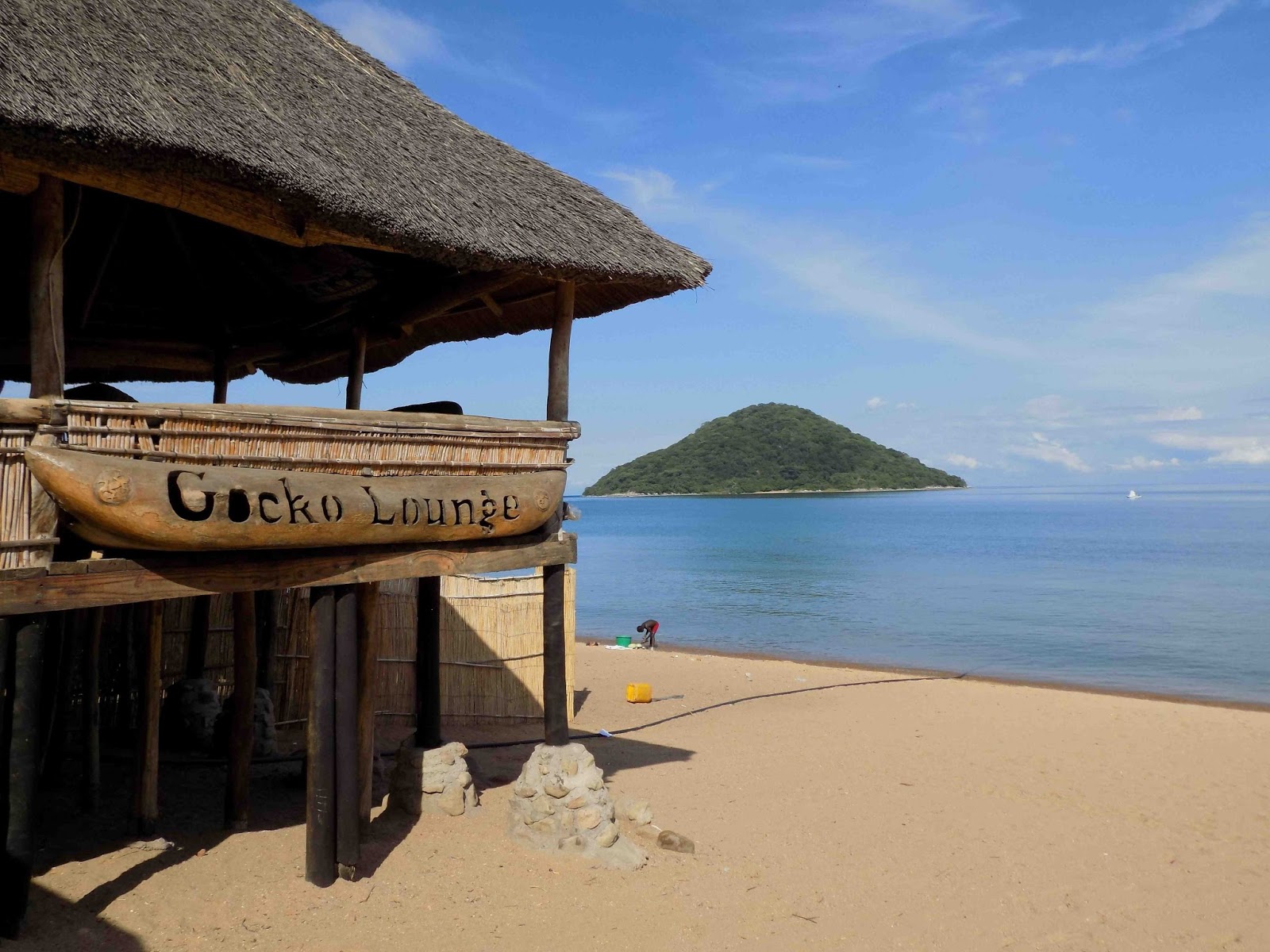
The next day we went to Mumbo Island. Now Mumbo Island is 11km away into the lake - not the island (Thumbi) that you can see in the picture above. Alex had heard that you could kayak there and against my better judgement persuaded me to join him. I enjoyed about 3/4 of the trip! I only agreed to go if we went in a double kayak so he could do the work if I got tired! 
If you're ever anywhere near Malawi I would seriously recommend visiting Mumbo Island. It's SO beautiful. This is the view from our little cabin:


The island is privately owned and has about 6 of these little cabins on it and an all inclusive restaurant. Otherwise it is totally secluded.


There were a couple of South African ladies staying, and a South African lady who was hosting as well as about 5 Malawian staff who did the cooking and cleaning, but apart from that we had the island to ourselves.

It was so interesting talking to the 3 South African's about life. They were really lovely, but is it fair to say they were very colonial? There was a lot of "us and them" chat in terms of race, and it really surprised me when they referred to themselves as Europeans, despite being 4th generation immigrants. 

We went kayaking and snorkelling and explored the island and went on a sunset boat trip. It was so much fun! 


The drive home was difficult because there was torrential rain virtually the whole way. I think we must have been in a bit of a bubble out on the lake because it looked like it must have been raining all weekend for the rest of the country. There was almost apocalyptic flooding in some of the villages.

Wishing you all a very Merry Christmas from Zambia!  

Wednesday, 14 December 2016

An Interesting Case (Not for the faint hearted...)

I haven't been sure how much to share with you guys about the kinds of things I'm seeing day to day in the hospital. A lot of the things I've been seeing are really very tragic and I'm not sure how fair it is to expose you all to that. Like most doctors, I've developed quite a thick skin, so unlike when I was in Ghana as a student, now not much will shock me. But I realise many of you are living very different lives and I don't want to upset anyone. Having said that, this is reality; we live in a broken world. Whilst most tragedy back home is hidden behind closed doors, it is happening and maybe it's ok to recognise that? 

However, the majority of the broken-ness I'm seeing here involves dead babies (being O&G) and I realise that can be particularly upsetting for some people, so I'll leave it to your discretion whether you want to read any further.

Yesterday I had a particularly interesting case, and whilst it had a partially negative outcome, I think it's an example of different specialities working together really well. I'm trying to promote unity between specialties so think it's worth highlighting!

I was on call for O&G and had a referral for a lady on the medical ward who was very unwell. She was a 15 year old girl with a positive pregnancy test and vaginal bleeding, who had also been vomiting with fevers for a week. On seeing her it was soon clear that she was very unwell. (For the medics...) she was tachycardic  ~140 (fast heart rate), febrile 39.3, and very tender on the right side of her abdomen with guarding. Initially we were concerned she might have had an ectopic pregnancy as they normally present in early pregnancy with L or R sided abdo pain and vaginal bleeding. James my reg did a bedside ultrasound scan, and found a pregnancy in the uterus (i.e. not ectopic - pregnancy outside of uterus that can --> death), but he couldn't find a heart beat so I took her to the ultrasound department for a proper scan. Adam, the surgical SHO, came to review her too as we thought it could also be an appendicitis.

She really wasn't at all well, but I managed to get her to the ultrasound department in a wheelchair and up onto the scanning bed. The sonographer started scanning, and there was the baby in the uterus, but again she was unable to get the fetal heart beat. As she was looking the baby moved across the screen. It took me a second to understand what had happened, but then I looked between the girls legs, and there was the baby on it's way out. After delivering the baby I tried to deliver the placenta but because the baby was so premature (probably about 20 weeks) with a bit gentle traction the cord snapped. This left me with a very sick young girl on the ultrasound bed with a retained placenta and literally no equipment, medications or midwives to assist me and 2 perplexed sonographers who really had no idea what on earth was going on.

I quickly wheeled her to labour ward, trying not to alarm the rest of the waiting room on the way out, and gave her some oxytocin (makes the uterus contract) and luckily the placenta passed shortly without too much difficulty. She was still very tachycardic, so I gave her some fluids and had a bit of a think. The whole story didn't really add up. It would have been tempting to be entirely distracted by what had just happened and say having a miscarriage at 20/40 is enough reason to be in a lot of pain and as a result be tachycardic, but the tachycardia persisted and there was the fever to explain. The baby showed no signs of an infected uterus (no pus/smell) and miscarriages at 20 weeks are unusual without an underlying reason. 

She was still very tender on her RUQ so I thought perhaps she might have cholecystitis (gallbladder infection) which caused the miscarriage. I called Adam who was on his way to review her again. He agreed that something wasn't right, although it wasn't entirely clear what. We didn't have any blood results back and she hadn't actually had a proper ultrasound scan, as we'd been a little distracted!

Adam thought it was more RIF, fitting with an appendicitis, so spoke to his boss about taking her to theatre. Proff (head of surgery) felt sure it was all gynae related but eventually agreed to do a laparotomy (open her up) anyway. Nothing happens quickly in Zambia, but later that night I got a text from Adam saying he was right, she had a gangrenous appendix and Proff owed him a bottle of wine!

So whilst there was one loss, less unwell patients have died here because things were missed, as could have so easily happened here if we'd been satisfied with "gynae pain" being a generic diagnosis. Nothing's straight forward here because we have such limited investigations and patients present SO much later here than they do back home (no one, even non-pregnant, EVER sits at home for a week with appendicitis in the UK).

We have a weekly morbidity and mortality meeting where each specialty takes turns presenting the deaths from that month. Often it gets really awkward because so many deaths here wouldn't happen back home, for a whole host of reasons, so people from other specialties can often be very critical. I really like this case because instead of a tragic death, every specialty contributed to saving her life: we had a very speedy referral from the medics, lateral thinking from O&G and good operating from general surgery (OK so no paeds...).