Tuesday, 13 December 2016

Kachipu Village

There's a man called Benson who works as a gardener for a couple of my colleagues and over the last few weeks I've become friends with him. He and his sons Daniel and Ferdinand have helped me with my garden a bit (more on that later) and he's just generally a really sweet guy. He has good English too, so it's really nice to be able to have a proper conversation with someone who doesn't work in the hospital.
He lives in a village a mile or two down the road from where I live and every now and then runs "village tours". This basically involves his kids picking us up in the ox cart (I think the same one the manure came in!) and then him showing us round the village, watching a dance/singing and then eating dinner that his wife makes.

This is Danger, one of our dogs. Or at least there are a number of animals who live on the hospital grounds that seem to be fairly communal and beg for food from whoever's silly enough to give them any - silly because as Kate, the latest arrival, discovered feeding them means they come scratching on your door at 5am! 

Danger decided to come with us to the village, uninvited, and spent the entire journey running between the oxen barking at them and biting their legs! I'm seriously surprised he didn't get kicked or impaled on a horn. Then as soon as we arrived in the village about 10 local dogs saw him and chased him round very aggressively for about 10 minutes! None of us were too upset - we tried to stop him coming, he's not unfriendly but can be a bit bitey, so isn't very popular!
The children in the village were VERY excited to see the mzungu and ALL wanted their photos taken about 20 times. I suspect they don't have mirrors so it's unusual for them to see their own faces.
So excuse me for the barrage of photos! This is the tip of the iceberg  just the ones where they stood still long enough to take a half decent photo!


About 10 minutes into the tour these boys came out, apparently dressed as ghost warriors  whatever that means! One thing travelling has shown me is that kids really are essentially the same wherever you go.


The girls put on a little dance for us. I took a video but the internet definitely won't cope with that!


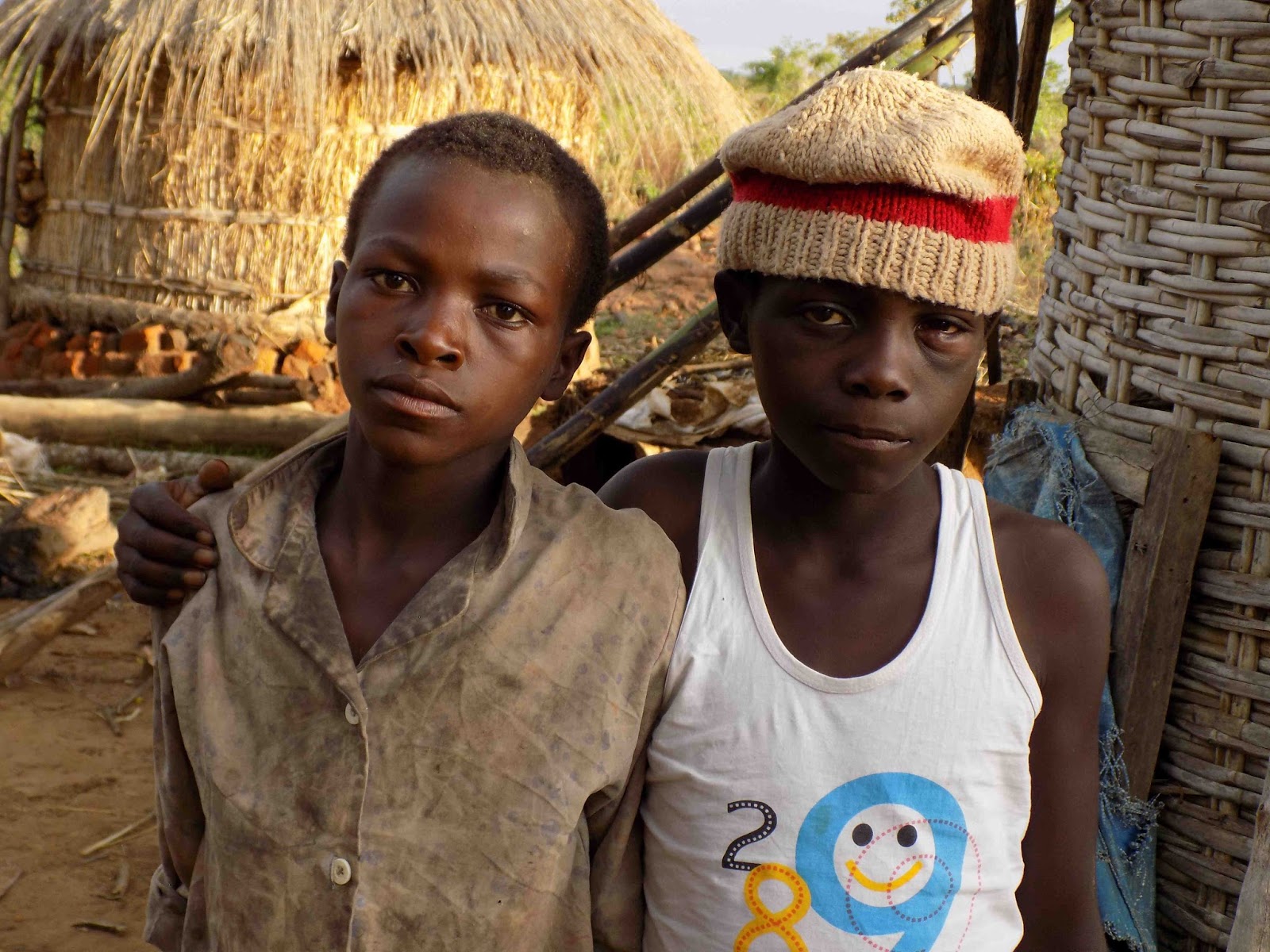
This is my favourite picture from the day. I love how serious they are.


The girl on the right is called Margret Zulu and she insisted on holding my hand the entire tour. To be fair lots of kids insisted on holding my hand, but she was the most persistent!


These women saw me taking pictures of the kids and wanted photos too. Then they wanted a photo with me, which they thought was HILARIOUS! I know they look very serious in the photo, but between snaps they were wetting themselves about getting a photo with a mzungu! Then they saw their brother and called him over for a photo too.

Collecting water


Benson is the man with the white cap, and the other mzungus are L-R: Alex (medical student), Adam + Sammy (both surgical SHOs), Kate (physio) and Robin (another medical student)

After looking round the village Benson's daughter Christa got the kids sitting down to sing us some nursery rhythms. None of the kids were really paying much attention, there was a lot of wandering about, but it was cute. I love how in this picture every child is moving except one who's looking at the camera.

 Then after the singing we had a candle lit dinner, made by Benson's wife, which was delicious. I'll do a blog someday on Zambian food! 

Sunday, 11 December 2016

New House

As requested, here are some photos of my new house and garden, where I'll be living for the next 6 months. 

The building is split into two rooms, one house on the left and another (mine) on the right. Inside is one big room with a kitchen area at one end, a bedroom area at the other, a living area in the middle and a walled off bathroom. 

Because the previous occupant moved out the same day I moved in I was able to keep all of her kitchen stuff


I've got some tinsel in an attempt to feel Christmassy!

Generally it's quite nice, but there's a big problem with the water. Most of the time it doesn't work at all and often it's just a dribble. I've only managed to get the shower to work twice (at a dribble), so the easiest way to wash is with a bucket. You just have to be organised enough to remember to fill it from the sink when the water's on. One great thing is that I've got a kettle in my new house, so I can have warm water (there's no hot water from the taps).
Bucket shower
Round the back is the garden:
I ordered some manure for the garden and this is how it arrived! How brilliant is that?!
The garden is a bit sparse, but I've started digging some beds to plant my vegetable patch. My neighbour Whyson (also one of my O&G regs) came to over while I was working and wasn't very impressed with my digging skills, so very helpfully did a lot for me! The ground is very hard and dry so it's hard work, and can only really be done in the evening or early morning as it's much too hot in the day.
The garden actually belongs to both houses, but since there's no one living in the other house I've taken over it all. Hope whoever moves in doesn't mind!
I've inherited 3 chickens from the previous house's residents, which makes me extremely happy! They have actually been promised to someone who's on holiday at the moment, but apparently it was quite a loose arrangement, so I'm hoping she'll forget!


I've called the black one nkuku (nkuku, with a silent n, is Chewa for chicken), the white one Martha, and the brown one Chicken Licken! Chicken Licken is a free range chicken who wanders around the garden and neighbouring area, but always comes home! I think possibly the other two are mean to her, because she spends v little time inside the coop, where as they spend very little time outside of it.

I've been waking up at 5.30 most days, partly because it's so light, but also because there are a lot of cockerels around that start crowing at first light. The Zambians believe that chickens won't lay unless they have a cockerel, so they all have one. Now all mzungu know this isn't a thing, so when my chickens previous owners found one of them was a cockerel they got rid of it, and apparently the exact same day they stopped laying! It's taken them 3 months to start again, and only one of them has.


Monday, 5 December 2016

Weekend Fun

I wasn't working on Saturday so a bunch of us drove to Chipata, the nearest town. There's a supermarket and most excitingly a hotel with a swimming pool! So while I hear it's been frosty at home, and you've been sat around the fire with your cups of cocoa, I have been sunbathing! 
It really doesn't feel like December... although it is rainy season, so it's not clear blue skies all the time. 
But really that's a good thing, cos it's already 30+ degrees everyday, and apparently was much hotter in October.


On Sunday I shadowed James my O&G reg for his on call. We had a very sick patient in the morning who had had an antepartum haemorrhage (bleed before giving birth). Joop one of our consultants came in and took her to theatre. Initially she had a c-section, where they found a HUGE clot behind the placenta, but she had an atonic uterus (won't contract properly) due to having had 7 prev pregnancies and the prolonged labour so they did a hysterectomy. She lost about 3L of blood (out of 4 or 5L total blood in your body) so none of us were very optimistic that she'd survive. 

We had the same problem as before of not having enough blood available. She had the only 2 units available during the operation, and as they were closing her up her BP was 62/35, HR 140 - really really bad. I knew she was the same blood group as me, so I tried to donate some blood for her, thinking this was the only chance of keeping her alive. We don't have the reagent to test for hepatitis C here, but I figured the very very small chance of me having it and giving it to her was worth it since the other option was likely death. The lab technician really didn't want to let me, and when I told him she would die without the blood he somehow managed to find a third unit in the fridge... So she had that third unit, her BP picked up a bit and so far is actually doing very well, all things considered. I don't like to make promises, but it's looking like she'll survive.

I found out afterwards that it's actually illegal to donate blood on the spot, because it all has to be screened centrally. This being said, apparently when it was the matron's relative who would have died without an immediately donated transfusion, this was temporarily forgotten... It's difficult - obviously you don't want people to die needlessly from lack of blood, but giving someone a blood borne virus from a blood transfusion is a very big deal, so you can understand why they have the law to protect people. It just doesn't work in emergencies.

Then on Sunday afternoon, in an attempt to feel more Christmassy, we celebrated Sinterklaas. This is a Dutch tradition where Sinterklaas (v similar to Santa Claus) comes and gives you all a present and a poem bought and written by another member of the group. As well as about 8 British expats there are 5 Dutch.
Joop my Dutch consultant dressed as Sinterklaas


James, one of the medical doctors, hearing what Sinterklaas' helpers have found out about him
There's a distinct lack of originality in names among expats - we have 2 James', until last week 2 Sammy's and 3 Alex's, out of about 14 of us! I think the Zambian's must think we only have about 5 names to choose from. They can't really talk though - literally about 50% of people have the surname Phiri or Banda, which makes life very confusing!

Saturday, 3 December 2016

First Week in the Hospital

Overall I'm really enjoying living in Zambia so far, but the hospital is a bit of a mixed bag. In many ways it's very similar to the Baptist Medical Centre that I worked at in Ghana, although it's about 2-3 times the size and has a lot more longer-term doctors.

I have a really great team of largely Zambian doctors and friendly Zambian midwives, so it's been fun getting to know them a bit, even if I'm struggling to remember everyone's names! I've been able to do a lot more practically than I would do back home, which mostly is great, but I'm a bit anxious that they will expect me to do things independently too early. This week I've been the primary surgeon (i.e. the main person doing the operation, start to finish) for one c-section for breech and one bilateral tubal ligation (female sterilisation), both with a lot of help from my registrars, and have assisted in a few more c-sections and other cases. In England I only did one c-section start to finish in my whole 4 month block on O&G, so it's fantastic to get to do one in my first week.

But there are also a lot of frustrations. The biggest problem on O&G at the moment is that we don't have enough blood. Most of our patients have haemoglobins of 3-5, some even 2, and a lot of the time we don't have any blood to give them. Haemoglobin should be between about 12 and 15. In the UK (in Exeter anyway) we give a transfusion to all patients if they symptoms below 8 and without symptoms below 7... So I've literally never seen such low Hbs in the UK - it's insane. On the whole they tolerate it surprisingly well, I think because they tend to be chronically anaemic, perhaps from recurrent malaria or poor nutrition, so the additional drop is less significant. But there have been women who have died because there isn't any blood to give them, which is so frustratingly unnecessary.

At the BMC, and I think probably many African hospitals, blood was sourced from the relatives at the time it is needed. This is a fairly good system as it generally means the blood is available, but can often take some time. For better or worse, we have a different system. While a quick check for HIV and hepatitis B + C can be done locally, the most sensitive testing is with a PCR machine, which costs hundreds of thousands of pounds. Unsurprisingly we don't have one here, so all the blood that is collected has to been sent for testing to Chipata, a town about an hour's drive away. After testing this then gets put into their general store which gets shared between all the local hospitals. It seems we're giving them a lot more blood than we get back, so although some is coming back it is no where near as much as we need. Even when there's blood to be had it can be a very slow process - today the testing reagent had run out, yesterday there was some other problem... 

As well as needing blood for emergencies, the lack of blood means a lot of our elective surgery is getting cancelled. We can't risk having a large bleed and not being able to transfuse them for a surgery that wasn't an emergency.
I hear there are similar frustrations on the medical wards. A lot of patients are dependant on oxygen therapy (e.g. if they have pneumonia), but the oxygen here comes from oxygen concentrators - machines that need electricity. At home we have oxygen taps on the wall, which if I'm honest I have never thought about how that works, because it's ALWAYS available so you don't need to think about it. But here when there is a power cut that means the oxygen concentrators don't work... There is a back up generator, but this takes time to come on, often time that patients don't have. Patients literally die when there's a power cut. The alternative would be to have oxygen cylinders, which don't need electricity. I might look into buying some as a back up, but it isn't really a long term solution as they will run out and need replacing very quickly... I had a long chat with Tim, a British GP who's here for 3 years about the politics of doing something like that - it would likely be a lot more complicated than it sounds.

Working in a hospital like this really makes you appreciate the care and resources we have available at home - that we all too easily take for granted.